Upper Body Exercises at Home: A Simple 25-Minute Workout
Upper body exercises at home can be done with no equipment. Get a practical 25-minute routine, progressions, and form tips for beginners.
Upper body exercises at home are a practical way to train your chest, shoulders, arms, and back without a gym membership or expensive equipment. This 25-minute routine uses push-ups, dips, pike push-ups, backpack rows, and resistance bands, with options for beginners and more experienced exercisers.
The short version
- Set aside 25 minutes and clear a small area with enough space to move safely.
- Start with a 4-minute warm-up, complete the 18-minute strength circuit, then cool down for 3 minutes.
- Use a sturdy table or chair for dips and a backpack filled with books or supplies for weighted rows.
- Choose two sets of 8–12 controlled repetitions, or one set of 10–15 if you are just starting.
What are the best upper body exercises at home?
The best upper body exercises at home are movements that train the major pushing and pulling muscles while requiring little space and no specialized machines. Push-ups, pike push-ups, dips, backpack rows, and resistance-band presses cover the chest, shoulders, arms, and back.
You do not need to perform every exercise in one session. Choose a balanced set of one push movement, one pull movement, and one arm exercise. If you have 25 minutes, a short circuit is enough to create a structured workout; if you have less time, focus on two movements and shorten the rest periods.
Push, pull, and carry the main focus
- Push: Standard push-ups, incline push-ups, or pike push-ups.
- Pull: Backpack rows, resistance-band rows, or supported pulling motions.
- Arm support: Dips, close-grip push-ups, or band presses.
- Shoulder and back control: Band lateral raises, band overhead presses, or slow backpack carries.
How long should a home workout be?
A 25-minute workout is a useful length because it leaves enough time for a warm-up, several strength exercises, and a cooldown without requiring a long training session. You can follow the timing below as a complete session or adjust the number of rounds to fit your schedule.
- Warm up for 4 minutes: March in place for 1 minute, circle your arms for 30 seconds, then complete 8–10 bodyweight squats, 8–10 scapular push-ups, and gentle arm circles.
- Strength circuit for 18 minutes: Perform the exercises listed below in order. Rest 45–60 seconds between exercises, or rest only as long as needed to keep your form controlled.
- Cool down for 3 minutes: Stretch your chest, shoulders, and forearms gently. Hold each stretch for 20–30 seconds and avoid forcing a range of motion that feels uncomfortable.
If your schedule is tight, complete two rounds of the circuit instead of three and spend the saved time on a longer cooldown. Consistency matters more than trying to exhaust yourself in one workout.
What equipment do I need for upper body exercises at home?
You need very little equipment for upper body exercises at home. Your body weight is enough for the basic routine, while a backpack, sturdy household object, and resistance band can make the movements more challenging.
- Push-ups: No equipment is required. A wall or countertop can make incline push-ups easier.
- Dips: Use a sturdy chair, bench, or low table. Check that it cannot slide and that you can support yourself securely.
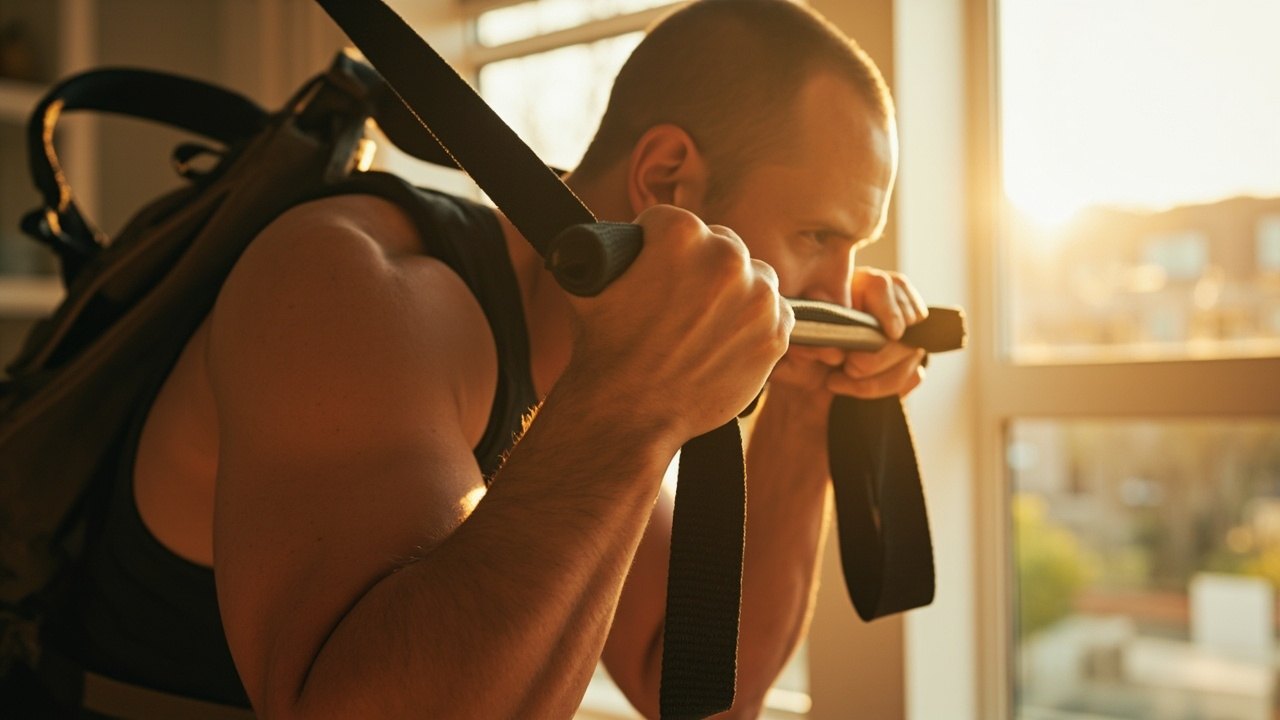
- Backpack rows: Fill a backpack with books, groceries, or other moderately heavy items. Zip it fully before lifting.
- Resistance band: A long loop band or a band with handles works for rows, presses, curls, and lateral raises.
- Optional mat: Helpful for protecting your hands and knees during floor exercises.
What does the 25-minute upper body routine look like?
The following routine alternates pushing, pulling, and arm exercises so you do not perform the same movement for the entire session. Keep the pace steady and prioritize smooth repetitions over speed.
- Incline or standard push-ups — 2 sets of 8–12: Place your hands slightly wider than shoulder width, keep your body in a straight line, and lower until your chest is close to the surface. Push away smoothly.
- Backpack rows — 2 sets of 8–12 per side: Sit on the floor with the backpack in front of you. Hold it with both hands, lean back slightly, and pull it toward your ribs. Lower with control.
- Bench or chair dips — 2 sets of 8–12: Sit on the edge of a stable surface, grip the edge beside your hips, and walk your feet forward. Bend your elbows to lower your body, then press up.
- Resistance-band overhead press — 2 sets of 10–15: Stand on the middle of a band and hold each end at shoulder height. Press overhead while keeping your ribs tucked, then return slowly.
- Pike push-ups — 1–2 sets of 6–10: Start in a downward-dog position with your hands under your shoulders. Bend your elbows to lower your head toward the floor, then push back up.
- Band or close-grip push-ups — 1–2 sets of 8–12: Use a band around your upper arms for added resistance, or place your hands closer together. Keep your elbows angled slightly forward rather than flaring them out.
Rest for 45–60 seconds between exercises. When two sets feel manageable and your form stays steady, add a third round. If you are new to strength training, begin with one set of each exercise and learn the movements before increasing the volume.
Make the routine fit your space
Small rooms are not a reason to skip strength training. Perform push-ups on the floor, use a wall for incline push-ups, and turn a backpack row into a standing band row. For dips, a sturdy step or low bench may be easier than a chair. Keep enough clearance around the exercise and avoid placing furniture on unstable surfaces.
How do I progress upper body exercises at home?
You can progress upper body exercises at home by changing the angle, resistance, range of motion, or number of repetitions before simply adding more exercises. Small changes let you continue challenging your muscles while keeping the movements safe and controlled.
- Make push-ups easier: Put your hands on a higher surface, such as a counter, and keep your body in one line.
- Make push-ups harder: Lower your hands to the floor, add a backpack to your back, or slow the lowering phase.
- Make pike push-ups easier: Use a higher surface and keep your hips only slightly raised. To make them harder, lower your body closer to the floor or hold the bottom position briefly.
- Make rows harder: Use a heavier backpack, pause at the top, or hold the weight with one arm for a smaller range of repetitions.
- Make dips harder: Extend your legs farther from the chair, pause at the bottom, or hold a backpack close to your chest while pressing up.
- Make band work harder: Use a thicker band, shorten the section of band between your hands and the anchor point, or perform slower repetitions.
Progress one variable at a time. For example, if you improve your push-up form but cannot control a full range of motion on the floor, remain on a counter until your technique is steady. If you feel pain during an exercise, stop, adjust the movement, and check with a doctor or qualified professional if you have a health condition, pain, or concerns.
Common mistakes to avoid
- Rushing repetitions: Use a controlled lowering phase and a smooth return rather than bouncing through the movement.
- Sagging or arching the back: Keep your trunk supported during push-ups and rows, especially when the exercise becomes difficult.
- Letting the elbows flare: Keep your hands a comfortable distance apart and allow the elbows to angle slightly forward.
- Using an unstable chair for dips: Test the furniture first and keep both feet planted or your heels close to the floor.
- Choosing a backpack that swings: Hold the load close to your body and keep the bag closed so the weight does not shift unexpectedly.
- Skipping the warm-up: Spend a few minutes moving your shoulders, arms, and torso before doing demanding repetitions.
Frequently asked questions
Can I build upper body muscle at home?
Yes. Home workouts can provide a useful way to train your upper body by using bodyweight, resistance bands, and improvised weights such as a backpack. Muscle growth depends on regular training, appropriate challenge, adequate food, and recovery, so gradually increasing difficulty is more useful than changing exercises constantly.
How many push-ups should I do in one workout?
Begin with a number you can perform with good form, such as one or two sets of 8–12 push-ups. Add repetitions, a third set, or a harder variation only when the last repetitions still look controlled. There is no need to reach a particular number for the workout to be worthwhile.
Are dips safe for beginners?
Dips can be modified, but they require a stable surface and good shoulder and wrist comfort. Start with a small range of motion, keep your back near the chair, and stop if the shoulder pinches or feels painful. A qualified professional can help you choose a suitable alternative if you have shoulder concerns.
What if I do not have resistance bands or a backpack?
You can still complete a full upper body session with your body weight. Pair incline or standard push-ups with chair dips, wall-supported rows, and slow pike push-ups. A filled tote bag can substitute for a backpack, while a sturdy table can support incline push-ups, but never use a surface that wobbles or cannot bear your weight.
Your next step is simple: gather your equipment, choose the exercises that match your current level, and complete one controlled round of the 25-minute routine. Record how the movements felt, then adjust one thing next time based on your form and recovery.